

Creative Tornado
Ke Francis's multimedia approach to Southern Narrative Art

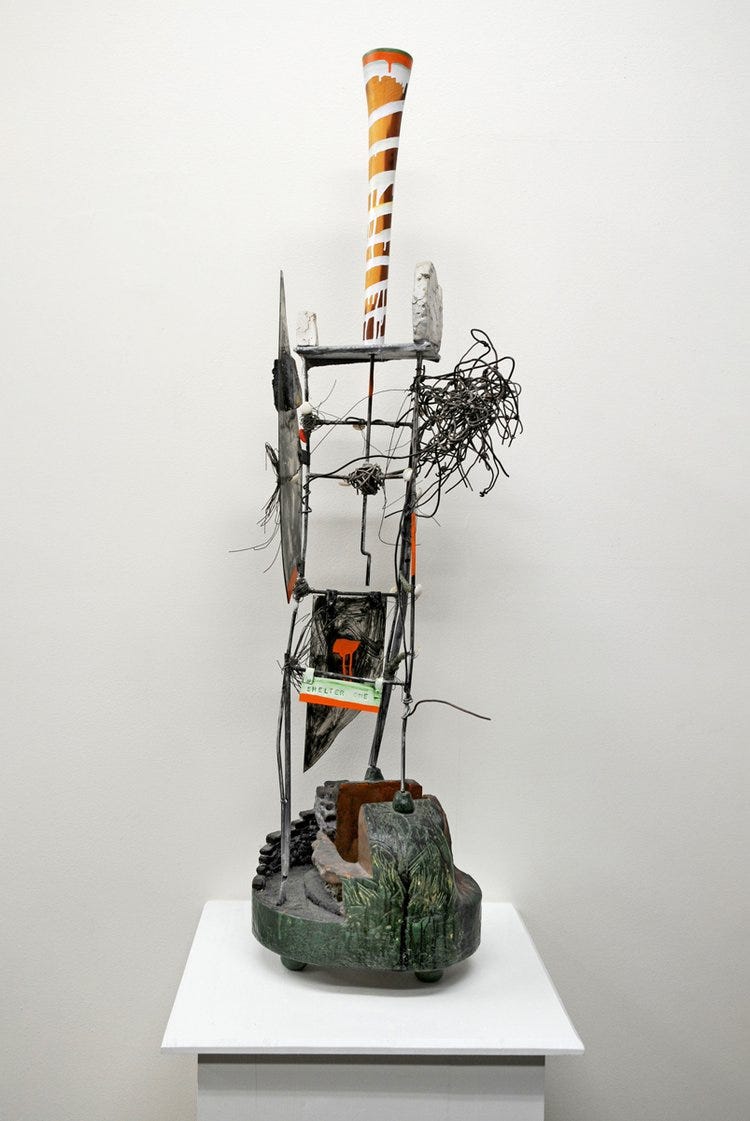
Ke Francis is a narrative artist and writer who has exhibited in major national and international museums over a career spanning five decades. He currently publishes his own limited edition artist books as well as collaborative projects with established poets, musicians and visual artists at HOOPSNAKE PRESS, which he founded in 1970. He is the 2023 Mississippi Governor's award winner for Excellence in Visual Arts, a former Rockefeller Fellow, winner of the Mississippi Institute of Arts and Letters award for Visual Art, a Southern Arts Federation Grant in Sculpture, and recipient of the Mississippi Arts Commission's Susan B. Herron Award for Visual and Literary Art.
Ke can you tell us how your art journey began with sculpture?
My grandfather taught me to use tools, repair machines, basic construction and woodworking skills. I was more comfortable, early on, with the idea of building things in real three-dimensional space than creating the illusion of the third dimension on a two-dimensional surface.
How do you decide which ideas should be books, versus a series of paintings?
The evolution of my multi-media form occurred in the following sequence:
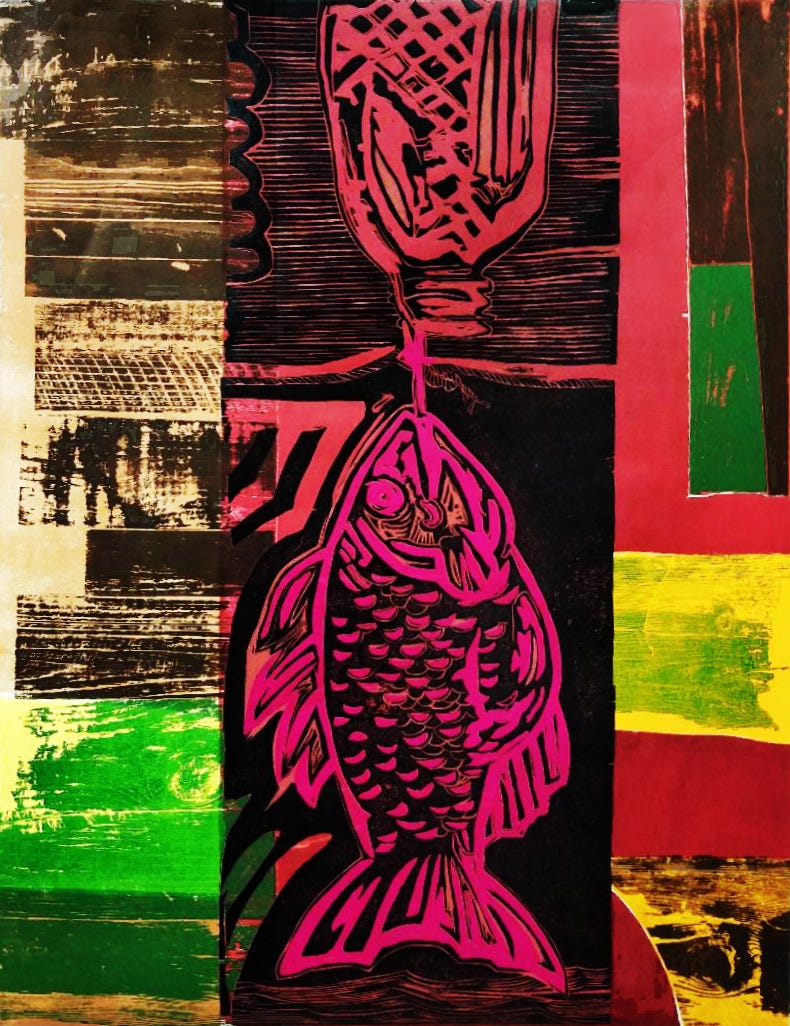
A. I slowly shifted my sculptural work from welded steel construction to wood carving because wood was an available and free resource in Mississippi. I shipped sculptures to competitions in plywood crates that were often damaged in transit. Rather than throw the plywood away, I carved images on it and printed the woodcuts in color. Pretty soon the sale of woodcuts exceeded the sale of sculpture.
B. The idea of multiples has always interested me. The making of multiples is a democratic artistic endeavor. The collector’s interest stems from the content and the desire to own “the only one in the world” is less important than the resonance of the image.
C. The woodcut printmaking process involves the application of transparent layers of color (one color for each block). It starts with a simple one-color matrix and grows more complex with each layer. This is a very simple way of making discoveries in the creative process. The use of transparent color is hard to predict. The color was often better than I imagined it would be.
D. The use of transparent ink led me to painting. I began to use fast-drying transparent acrylic paint and built the painting in layers rather than mixing white with slow-drying oil paint to carefully blend and model shaded forms.
E. The crossover in the various mediums led to a comfortable and productive use of time. Painting was immediate and results appeared rather quickly. Printmaking was slower but it integrated the imagery from painting and sculpture and often led to color that I wouldn’t have thought to mix for the paintings. Sculpture was slow but delivered the content in a different way because the viewer could walk around the content (object and experience it in real time / space and not as an illusion.
F. When I did exhibitions of my work and did gallery talks the people who attended the talks would ask me to “explain my work”. I tried to do this but it satisfied neither me, nor my audience. After a few of these attempts I realized that my explanations seem to steal the magic from the artwork. I realized that what the audience wanted was not an explanation but a simple confirmation that the person who was standing before them was the personality (had the same emotions that they were feeling from viewing the work) that had created these images and objects. They wanted to know that the artist and the work were “authentic.” I decided to tell stories, experiences I had that led to the creation of those artworks, or dreams that led to surreal, or more imaginative images. This satisfied the audiences and I started writing the stories down so I could read them when I showed the work again. It occurred to me that what I was compiling was a group of short narratives and if I elaborated on them, and expanded the narratives in a creative way I would create short stories.
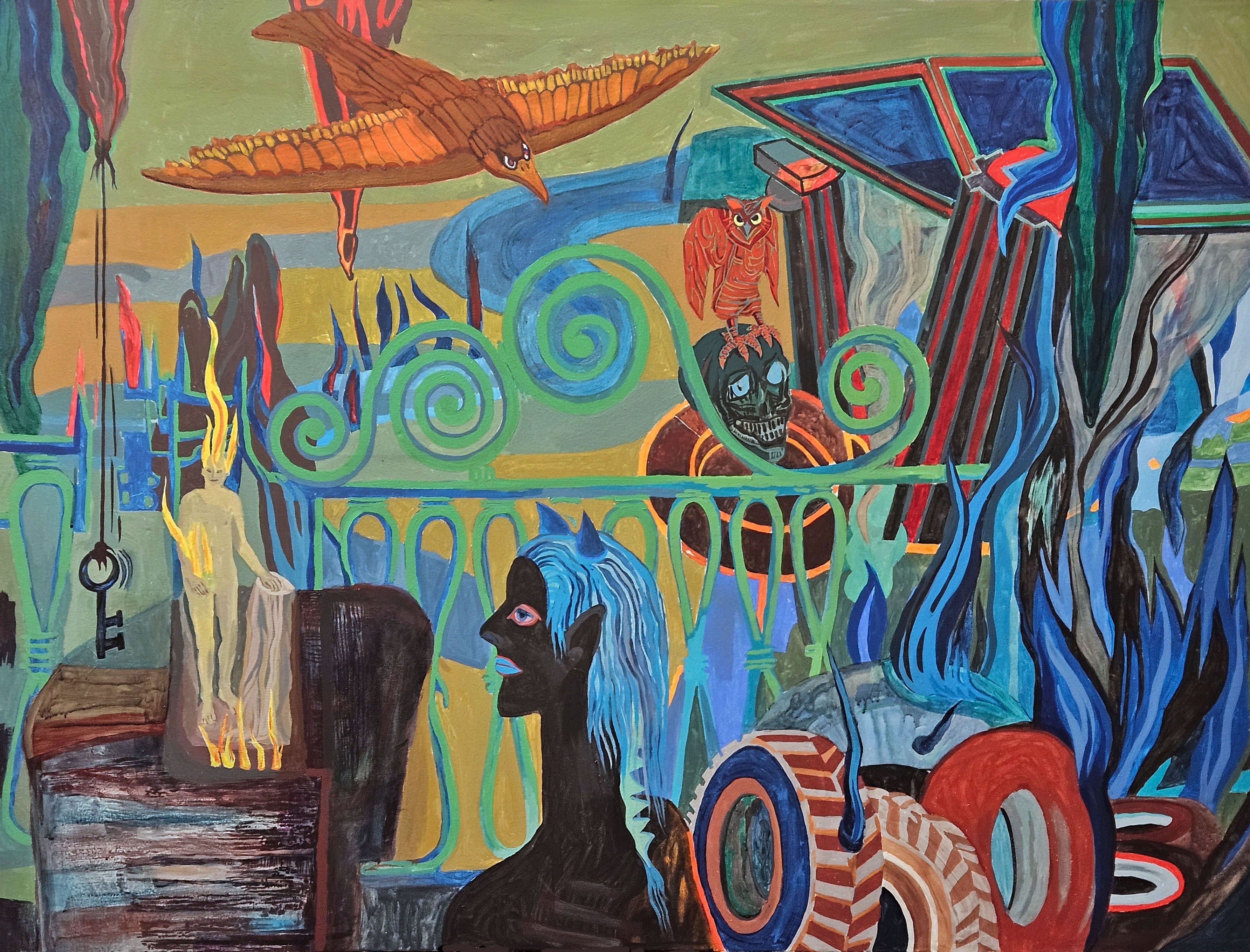
G. The stories led to paintings and prints, and the prints led to sculpture, and the sculptures led to installations where I combined the paintings, the prints, and the sculptures and told the stories. When an installation is installed in a room, our vision encompasses 180 degrees. This 180-degree view will comfortably take in two walls of a space. A classic, traditional book, when opened, has two walls that will accommodate text and image.
H. The development of books (multiples) was a further exploration of my inventive process. To make books in the same way I approached my paintings, prints and sculpture was more difficult. The making of a book in the twenty-first century requires, at a minimum, a writer, an editor, an illustrator, a designer, a printer, and a binder. If I was going to move through the making of a book in the same intuitive way I made a painting then I would need to do each step of the process myself (my wife is my editor) in order to make the changes in the work that had been carried to completion much earlier if I saw a possibility to improve the work as I was working on a later sequence of the production. The way the commercial process currently works is that each process is carried to completion and passed to the next craftsman to do their part of the process. The binder has very little input into the development of the story line or the ideas of the illustrator or designer.
The answer to this question you asked, is that the whole creative process is constantly working in a circular system of invention. A mistake in a sequence of printed pages may be solved by cutting the pages of the printed section and re-arranging them as a fold-out so that the sequence is restored. The fold-out section may require a stiff form to allow the fold-out to stand erect if the book is displayed standing upright. The fold-out may result in a blank side when the images are re- sequenced in the fold-out and a new painting may be required in the series of paintings to fill the blank page in the book. The new painting may yield an idea with new content that will add a new dimension to the story so an additional page of text (perhaps a stand-alone poem) is added, with a similar parallel thought as the story…so the story is expanded.
One of your many mediums is photography – how did your Italy-America photo pairings come about, was that related to your Fellowship in Bellagio, Italy?
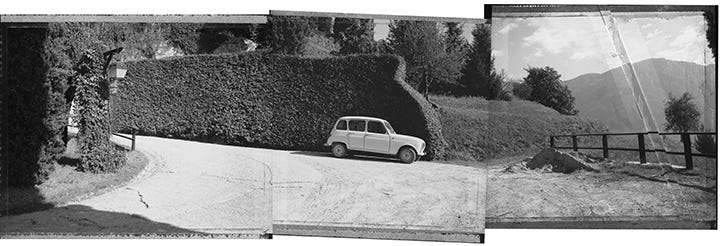
I was a resident at the Bellagio Study Center, and I had a grant from the Polaroid Foundation to do a photographic project while I was in Italy. Polaroid provided me with a crate of 4 x 5 inch positive/Negative instant film. I took a tripod and an old Speed Graphic press camera with me to the study center. I was furnished with an art studio, and I worked on drawings and pastel paintings and, if the light was particularly nice, I would wander out into the city with the camera/tripod and a pack of film. The instant assessment of that environment was that the space was packed tight with loaded imagery and the only way to capture that was to put the camera on a tripod and shoot three or four shots and rotate the camera at each shot to create the panorama. Sometimes I just shot several shots of the loaded content in the environment and taped them together.
Years later I continued the series in America and tried to find subject that were, in some way, like what I had shot in Italy.
During my evenings in Italy, I wrote an interesting short story about an American, traveling through Europe, who met a German woman, the wife of a German mercenary, and that led to interesting encounters. The resulting project, Italy/America includes a series of paired photographs from Italy and America and the short story, together in a custom-made case.
You’ve described your path from thingamajigs through combi-whatnots to whatchamacallits… can you say more of how mechanical reproduction and multiples factor into this?
Like most artists, I am a product of my culture and my time. I emerged from a culture with very little interest in “fine art” but a strong and practical understanding of quality “crafts.” Handmade functional ceramics, toys (carved paddle-dancer puppets, whirligigs), hand woven reed basketry, quilts and fine cabinetry were all appreciated, and in some cases, collected. Any handmade object that did not have an apparent and practical function fell into one of three categories: Thingamajigs, whatnots, or whatchamacallits.
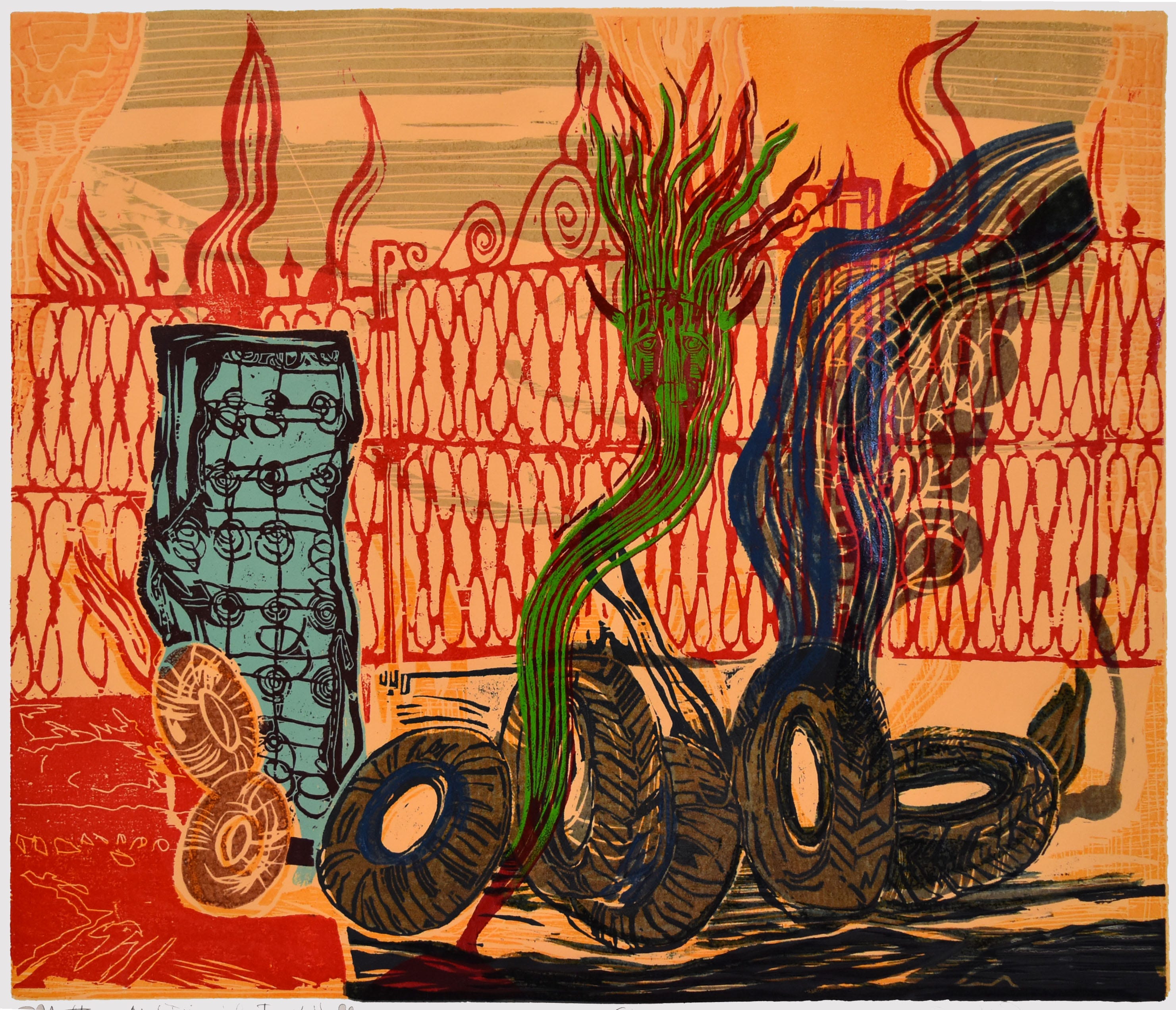
My work, from the very beginning, has not been designed to answer questions or to be functional, but to raise interesting questions. I have produced work in each of the three groupings. All of them have referenced functional objects, etc. but the last work looks more familiar than the earlier work, but it is hard to come up with the exact words to explain it. They seem like a complete set of things; a room full of seemingly related objects that are well crafted. At the core of the grouping seems to be a story that is complete but seems related to the surrounding objects and since the objects have no practical function BUT HAVE SOME SURREAL RELATIONSHIP TO THE STORY AND THE OTHER OBJECTS, the whole collection are a group of whatchamacallits.
These whatchamacallits are beautiful (could beauty be described as a function? Not in the world I emerged from!!) The works have a sense of order. Is placing non- functional objects in order a defined function? Does the work serve a psychic function? One way or the other they seem to stand alone in their completeness. The questions that evolve from these complete sets raise timeless questions.
Recent technological breakthroughs have made a lot of very functional and useful equipment available to artists at cheap prices if they will simply haul it away, I use “state of the art” computer technology and re-purposed obsolete machinery to make multiple ordered sets of objects that raise timeless psychic and philosophic questions (beauty?)
Do you have a particular creative process to get from concept to finished piece, or is it an open-ended, unpredictable path?
I start with a clear plan and proceed until I make a mistake, then the plan falls apart and I must depend on my wit and intuition until the project is complete.
Most often I find, both in my work and in other artist’s work, that work that proceeds without out a mistake is most often plagiarized, or it is work that is a simple repetition of ground they have already explored and not really new work.
What obstacles have you encountered in your journey with Hoopsnake Press, and how is the world of book collectors different from that of fine art aficionados?
Book collectors (I am speaking generally here) place their books in glass cabinets, in well-ordered, personal libraries. They rarely show their collection unless another collector comes to visit.
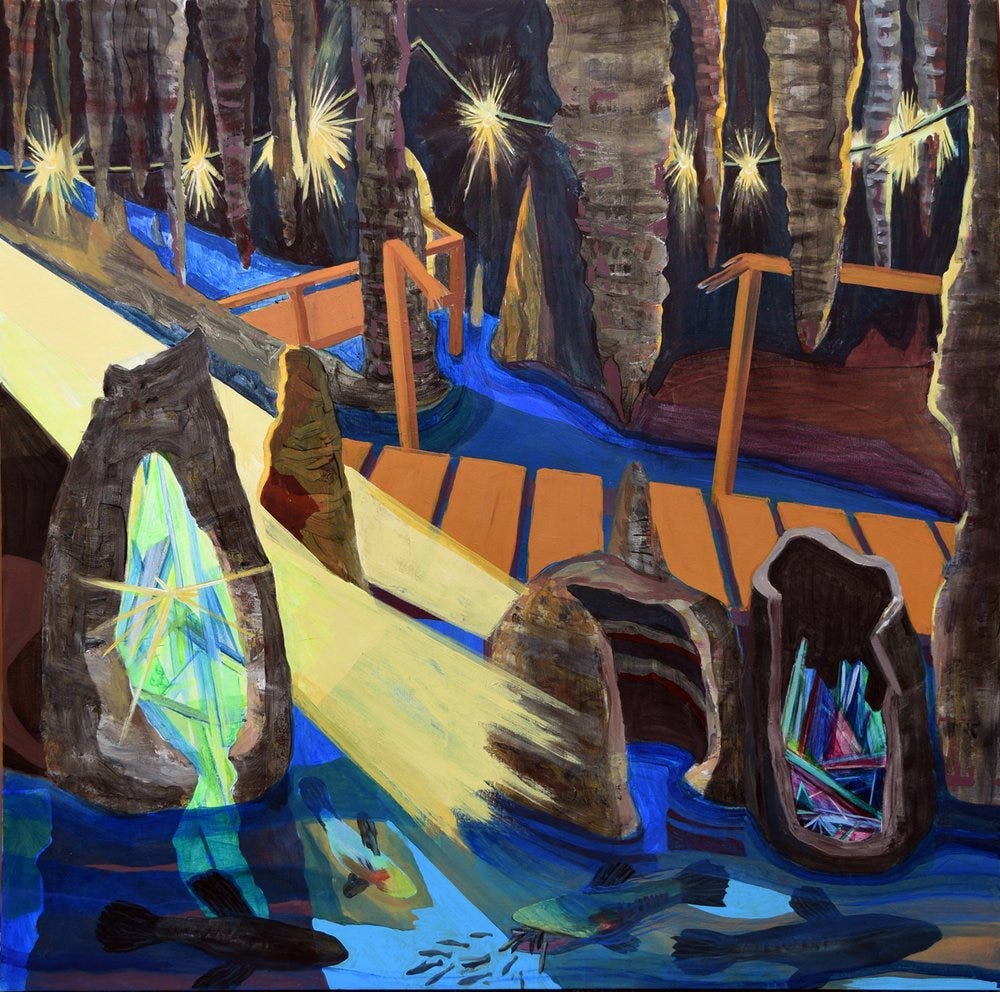
Art collectors buy work that is going to be openly displayed, and they prefer it to be signed because it is important to these collectors that their guests understand who made the work they own. They place the work in a highly visible setting.
If you tell a book collector that you have work in the Getty Museum they will just shrug and then they will do what they have done with every book they have purchased. They will hold the book up to eye level and view the spine to see if it is straight. They will open the book and slide their hand over the paper to see if it is of quality and whether the type has embossment or not. They will read the first page to see how the author kicks off a story. They may then read up to twelve pages if they don’t know the author. Then, they will open the book and see if the binding has been sewn or glued. Lastly, if they want the book they will ask the price. They don’t care who else has purchased the book. They know what they consider important and it doesn’t matter what any other librarian or curator thinks about the book.
If you tell an art collector you have a work in the Getty Museum they will stop and look carefully at every work you have available. The fact that a major museum curator and a museum purchasing committee has agreed to assume ownership of one of your works is very important to them. It is something they can use to defend their purchase if challenged. Art purchasers rarely have any historical references that explain how artists functioned in their culture. They approach buying art the same way they buy anything else. They look for recognizable branding (as determined by consistent style and recognizable content.) A large number of art purchases are made based on the decorative impact of the work. That is a much different market than the market of collectors.
The problems I have faced at Hoopsnake press has mainly been a problem of distribution. The cost of producing a book the way I produce books (in extremely limited editions) means that people who are used to paying thirty-five dollars for a signed copy of a famous authors work find it very difficult to pay the same price for a book of mine with original signed prints and an interesting story that they would pay for one signed limited edition print of mine.
Did you study poetry and fiction writing, or are mostly self-taught?
My writing evolved from the stories I told at the openings that related to my visual work. I took classes in English composition in college, of course, but my creative writing has evolved on its own.
You’ve taught workshops in Scotland, Germany, Belgium –do students in the different cultures take different approaches, with diverse results?
My foreign teaching experience has been limited to European countries with museum collections that house artworks from around the world. These collections contain cultural objects that mark the beginning of recorded history. These art students, who regularly visit the museums, have a clear idea of the various roles artists have played across the centuries. Often, the only things we know about a culture are the things the artists had recorded. The students in the countries in which I have taught seem to focus more on the timeless aspects of art and less on styles or quickly changing trends in the American art scene.
What are some favorite travel memories?
After the Berlin wall came down. I traveled, courtesy of the World Print Council and the U.S. Information Agency, through a number of formerly Russian controlled sectors of East Germany. I went to a number of cities to install an exhibition of collaborative American artworks entitled: Crossing Over/Changing Places. For several nights I was housed in the visiting artist apartment at the Berlin Academy on the famous avenue Unter der Linden where the Nazi parades were held. When I left the apartment to go to dinner the avenue was lined with male prostitutes waiting for Johns, most dressed like Elvis impersonators, fringed white chaps, vests and jackets and various sequined and silver capes, etc. I was impressed, of course, since I was from Tupelo (Elvis’ birthplace). It was strange to think that years before, storm troopers had marched along the same avenue.
During that same tour I had lunch with several mayors of the cities where I was installing the exhibit. It was explained to me (by one of the mayors) that most of the mayors and administrators of European cities had art history degrees because they were ultimately responsible for the museums, the art collections and the irreplaceable architecture that were their culture’s most valuable components.
I think this is a particularly interesting memory considering the current U.S. federal administration’s defunding of arts and humanities agencies.
What is one of your favorite pieces or series?
For more than forty years I have worked on a series of tornado photographs, stories and interviews. Here is a favorite:
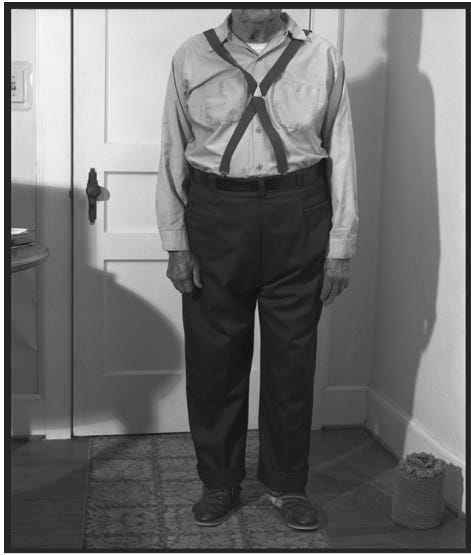
By the time the tornado of 1936 struck Tupelo Judge Long had retired twice. He had retired from the bench, and following a fine dinner prepared by his daughter, he had retired for the night. He had climbed the stairs to his bedroom, pulled his suspenders from his shoulders, removed his pants and hung them on the bedpost. He heard the wind gathering to a roar, looked out his southwest window and saw the dark funnel cloud moving directly towards his house. Pulling his pants from the post and quickly onto his legs without concern for their orientation, he raced down the stairs to warn his daughter, but she had already left for her evening date. The tornado struck the house and tore it in half, throwing the judge into the nearby shrubbery and covering him in debris. The daughter and her boyfriend rushed home to find the judge unconscious in the hedge. Once they had revived him, he stood up and looked down at his suspenders crossed uncomfortably across his chest and then he looked down at his pants.
The judge swore until the day he died that the tornado had “turned him around in his britches.’
What advice would you give to aspiring interdisciplinary artists?
I became an artist because it seemed the most open-ended profession I could choose. It was my idea that I would be able to pursue all of my research interests and the result could be simply termed “ART”. All of the arts are highly competitive and require endless study, long hours and the constant pursuit of quality craft. Getting recognition is always a slow process and one must be satisfied with personal development and quality self-expression as the ultimate reward. Anything that happens beyond that (sales, exhibits, commissions, etc.) is a bonus.
What artists have influenced you? Did you ever get to meet any of your heroes?
I haven’t had any particular art heroes. I have been lucky enough to have exhibited with, collaborated with, and been friends with many of the best artists, poets, and novelists of my generation.
What are upcoming plans that you're excited about for your personal work or Hoopsnake?
I am presently finishing (at the binding stage) a short story (42 pages) Devil and the Mudcat, and a related portfolio of prints (currently binding and building cases) to be distributed in 2026.
I am also publishing a collaborative poetry and print portfolio project, White Shadow, with my long-time friend, the poet Michael Hannon from Los Ossos, California, also for distribution in 2026.
I recently finished (and have available) two new books of my poetry:
Isis In a Crisis, Isis and Osiris leave Egypt, Mississippi to make their way up the Mississippi to the Pyramid in Memphis, Tenn.
True North, A selection of poems by Ke Francis, 2011-2025
You’ve lived a number of different places – Tennessee, Ohio, Florida, Mississippi – how did you decide to stay in the latter?
I built a studio and established my professional career in Tupelo, Mississippi in 1970. Tupelo is a progressive city with a strong and diverse economic foundation. The galleries that I worked with from 1970 until 1996 were in Memphis, Atlanta, New Orleans, Birmingham, Knoxville, Kansas City and Washington, D.C. Tupelo was located less than a day’s drive from all those galleries.
Over the years I established Hoopsnake Press there, added another building and converted buildings that had belonged to my family to a woodshop and a large darkroom and a ceramic studio.
I never sold the land, or the studios and they remained in my family. When I retired from the University of Central Florida, my daughter suggested that I return to Tupelo and return the press to the original facilities. My wife Mary has two daughters that live in Tupelo and my daughter, two granddaughters and a great grandson all live nearby. I live in the renovated house my grandfather built in 1939 and I work, every day, in the same studio I built in 1970.
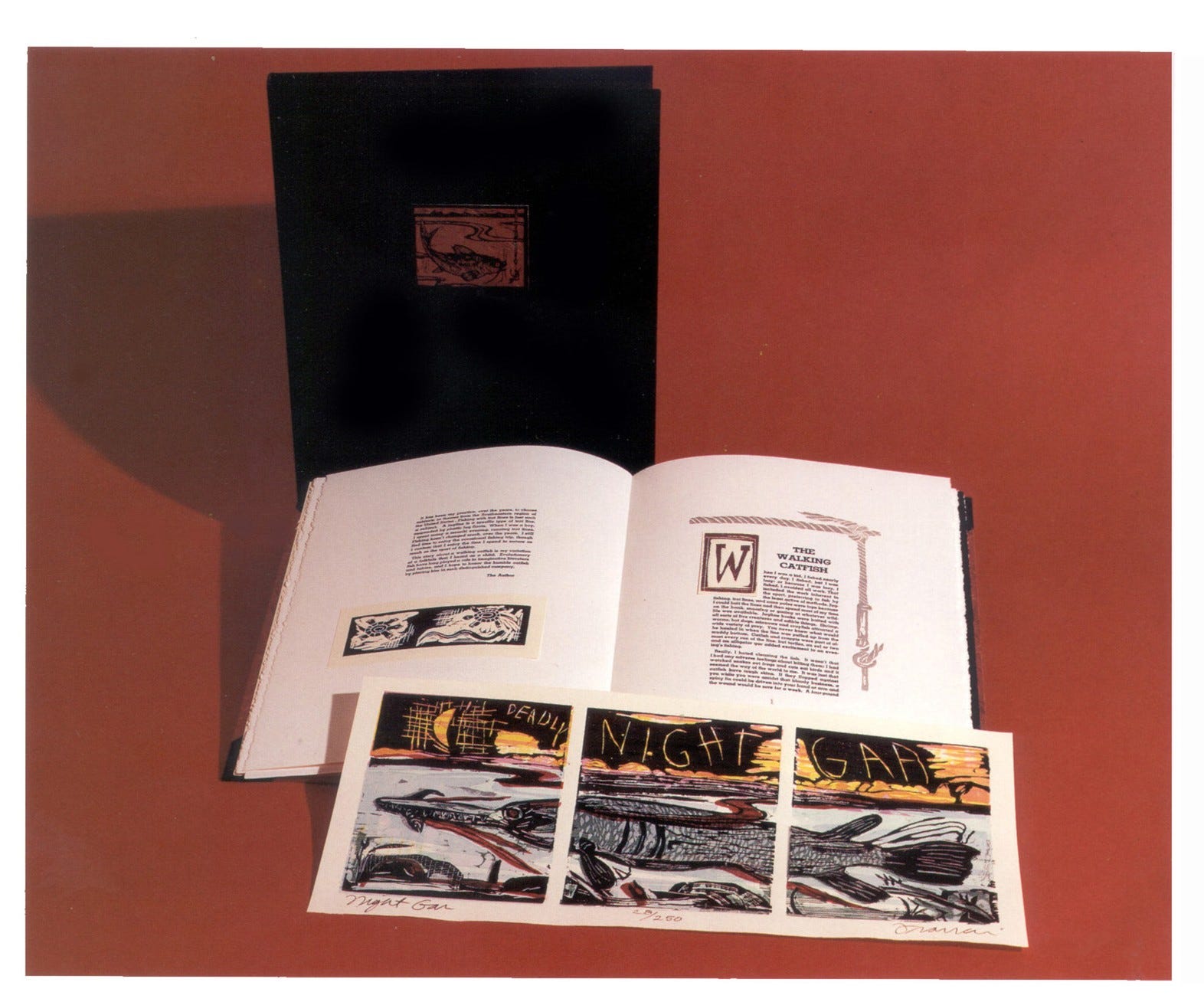
See more of Ke’s available work at floridamininggallery.com