

Magic in Many Forms
Shea Slemmer taps ancient energies to navigate human experience

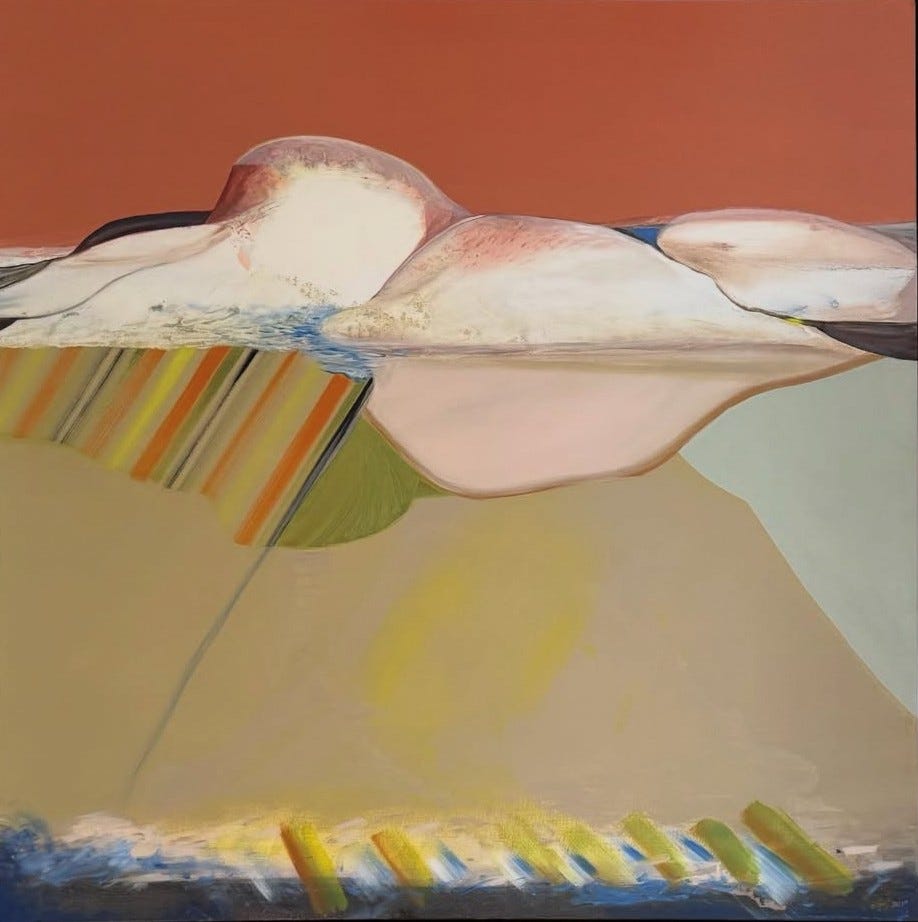
Shea Slemmer grew up in the pastoral horse country of Ocala, FL. After receiving her BFA from UNF in Jacksonville, Slemmer set up a studio in Savannah, and has also worked in New York and Marfa, Texas. Slemmer’s works can be found in collections across the U.S. and Europe. Her recent solo exhibitions include Sweet Lorraine Gallery in Brooklyn, NY and The Telfair Museum in Savannah, GA. Her ethereal works have been published in Studio Visit Magazine, Atomic Ranch, Savannah Magazine and South Magazine.
Shea you chose University of North Florida for college, among the many schools in the state - What were some of your biggest art breakthroughs or influences there?
UNF was a wonderful experience for me. I had lunch one day with Nofa Dixon who was an art professor there and someone I looked up to. She suggested that I pursue my degree and at the time I really didn’t have a particular direction so it sounded good to me! I had the pleasure of studying under her and other really talented artists like Jim Draper, Raymond Gaddy and Louise Freshman Brown. A big breakthrough happened for me with a study abroad in Rome with Debra Murphy. During that trip I learned to see light in a different way and it still influences my work today.
How did you end up setting up a studio in Marfa, Texas? Did you experience the orb lights there?
Marfa was the last stop for me on a cross country road trip. I had traveled 5,000 miles over the course of three weeks on a pilgrimage through Colorado, New Mexico, Arizona, Nevada and Texas. Marfa was love at first sight. I couldn’t stop thinking about it after I made it back to Savannah and decided to go back, build a studio and paint the big skies of the high desert. It was transformative to say the least. In the two years I was there, I saw the Marfa lights once. I experienced magic in so many forms and I think of it often.
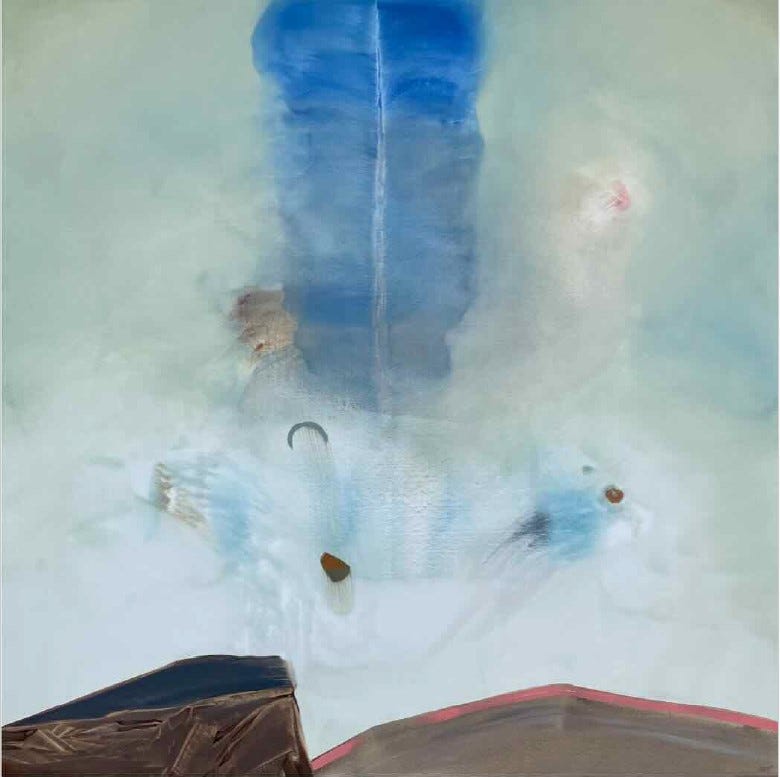
You mention that your paintings reflect the path of your healing journey. Do you care to share more of that process?
In the past I have referred to the process of making art as the art itself. I release expectations about the end result and enter into a state of flow so that I can channel source energy. It is where I center myself in truth and navigate the complexities of this human experience.
Can you tell us about growing up on a self-sustaining organic farm? Was it freeing, or restricting?
My love for Mother Earth comes from my childhood. It is something I am proud of. I grew up near an Indian reservation which we traded goods from the farm with regularly and sometimes we participated in ceremonial customs. This solidified my ideas about being a custodian of the land I inhabit. My parents still maintain a homestead in the Ozark mountains that is completely off the grid and to this day I have reverence for that way of life.
Your interview in South magazine says your first paintings were on the walls of your house in childhood – was that encouraged, or did you get in trouble?
Oh my, so much trouble! My mother would hide the pens from me. Especially when I was sitting on the phone and the note paper ran out.
Mentioned in your art statement are ‘sacred alchemy, source energy, divine maps between timelines’… do you have spiritual practices outside of art where you pursue such transcendence as well? Are you a stargazer or oneironaut?
After a few trips to Monhegan Island in Maine I started to practice bilocation and lucid dreaming. I have been fortunate enough to visit very ancient energies which I am sensitive to. I have traveled to places seeking out the darkest skies to sleep under a bed of stars. I love the feeling of being a tiny spec in the great vastness of it all. Some of my paintings explore the idea of being alone but also connected to everything. Feeling like you are one the edge of a cliff with a great ocean ahead, a precipice, or embarking on a long journey.
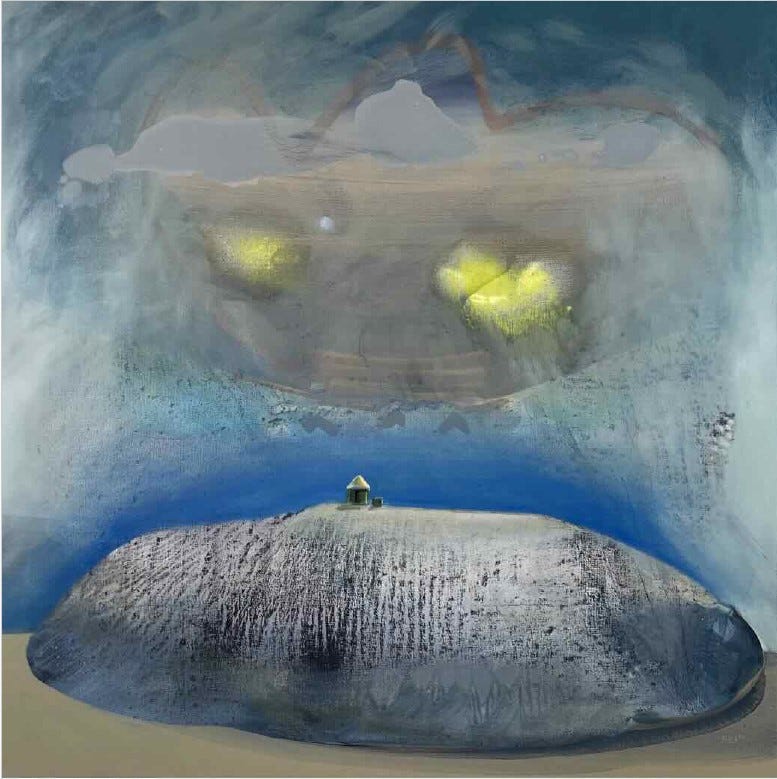
Poetry seems prominent in your writing, has that been something you’ve studied as well?
My grandmother, Carol Slemmer, gave me a journal every year and encouraged me to write. I used to get discouraged because it was never the neat, consecutive entries like hers or her mother’s before her. I write in a chaotic way, skipping pages and scribbling in the margins. After time, though, I began to rely on the journals and notebooks strewn about the studio. The ideas that come through the flow state are usually like a West Texas summer monsoon. Fast and heavy with purpose and prominence but gone in an instant. Transcribing those moments into words and later poetry are the clues I need when it is time to make sense of it all.
You point to environmental influences on your work – the “safety-yellow swirl of energy” in NYC, and the “sticky cicada song after a thunderstorm” of Savannah. Are there other places you might like to explore for their effects on your process, perhaps through residencies? Iceland? North Africa?
I want to go everywhere. I want to see everyone and love everyone with my whole heart. There is nowhere I would say no to if given the chance.
Your brother says he was honored as a VIP when visiting Ft. Pickens in Pensacola, as your family is related to Lieutenant Adam Slemmer who saved the fort for the Union in 1861. Have you ever visited? Was it odd growing up in the South with such a heroic ‘yankee’ connection?
I will admit that I am probably the least interested in that part of our family history. I have never been able to identify with war even though almost every man in my family has served in one. My utopian agenda looks only for pathways to peace.
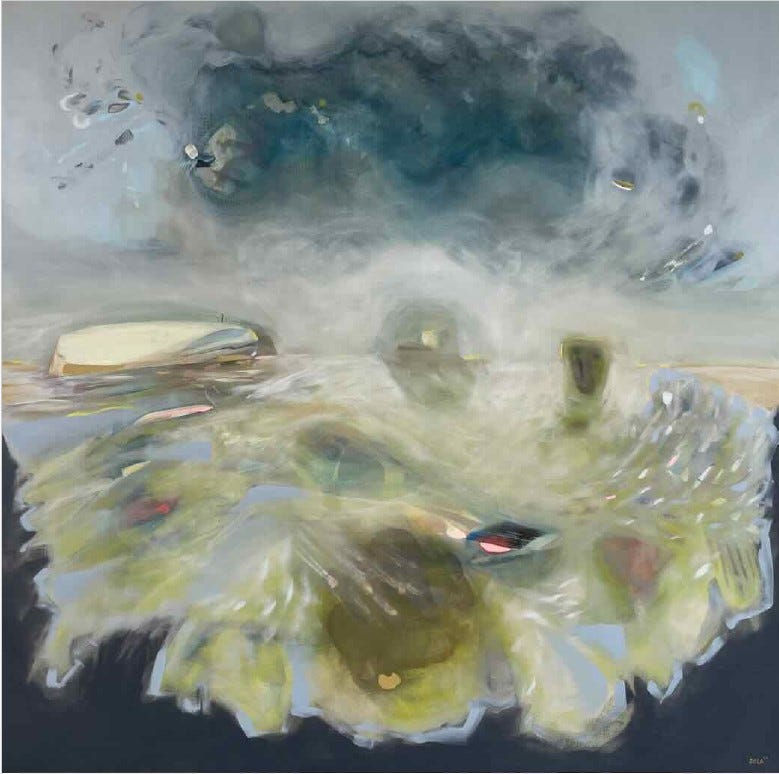
You have collectors in Europe, which sounds very exotic. Are you able to say more about that and how you’ve cultivated international appreciation?
I love that it sounds exotic when the roots of it are so humble. Early in my career I was hired several times to paint large pieces for international corporations building manufacturing facilities here. The flattering part was that often times they would take the paintings back to Europe with them instead of leaving them in the lobby.
How has your relationship with interior design companies developed? Are there tips you can offer other artists about integrating their work into the built environment?
Interior design is another great love of mine and I’m honored to work with designers all over the Southeast. My advice to other artists would be to let your authenticity be your guiding light so that you work lands where it belongs. It’s the best way to find what is truly meant for you and your practice.